Published · Last reviewed · Plume editorial desk

Issue No. 2026 / Winter Edition

Guide · Movement

Strength as a conversation with time.

Movement can support capacity, mood, balance, and independence without needing to become a performance.

The most useful exercise plan is one that leaves enough room for the rest of your life.

Build a broad base

A balanced week may include walking, resistance, mobility, and periods of lower intensity. Start from what your joints, schedule, and current experience can reasonably tolerate.

New pain, chest symptoms, faintness, or unusual breathlessness should be discussed with a clinician rather than pushed through.

Physical activity guidance from the World Health Organization for adults generally describes a mix of aerobic activity and muscle-strengthening work across the week, adapted to the individual. For many working men, the largest practical barrier is not knowledge but time and energy. That is why this guide emphasises small sessions, simple equipment, and the use of ordinary spaces such as a living room, a stairwell, or a nearby park.

It is also reasonable to begin below your perceived capacity. Early sessions that finish with energy to spare make it easier to return a day or two later, and the sense of competence that follows is often more motivating than any single hard workout.
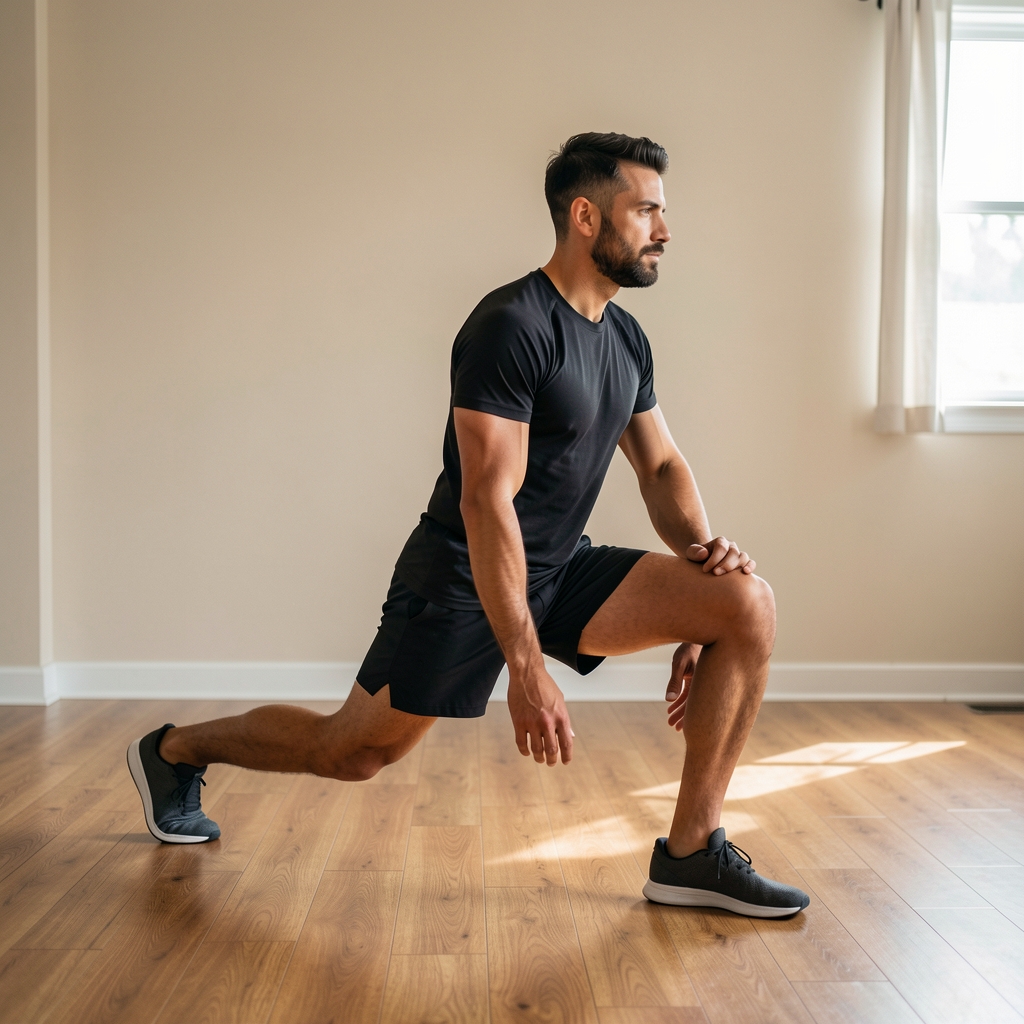
Adult man practicing a controlled lunge in a simple home movement room with wooden floor
Three principles

Capacity, skill, and recovery

Capacity

Increase demands gradually so the body has time to adapt.

A commonly cited approach is to change only one variable at a time, such as the number of repetitions, the weight, or the number of sessions, and to hold each new level for a couple of weeks.

Skill

Learn comfortable technique before chasing intensity or volume.

Practising a movement slowly, with attention to joint position and breathing, helps build a pattern that can later bear more load. Video of yourself, a mirror, or a session with a qualified instructor can be useful.

Recovery

Rest days, food, and sleep help make movement sustainable.

Muscles adapt in the recovery period, not during the session itself. Planning at least one or two lighter days each week is a standard feature of well-structured routines. You can read more in the recovery guide.

A sample week

One way to arrange movement across seven days

The template below is an illustration for healthy adults with no restrictions on activity. Please adjust it to your own situation and discuss it with a clinician or qualified trainer if you have a medical condition, injury, or have been inactive for some time.

DayFocusExampleApproximate time
MondayStrength, lower bodyChair squats, step-ups, glute bridges20 to 30 minutes
TuesdayWalkingBrisk walk at a conversational pace20 to 40 minutes
WednesdayMobility and restGentle stretching for hips, shoulders, and spine10 to 15 minutes
ThursdayStrength, upper bodyWall or incline push-ups, band rows, carrying a bag20 to 30 minutes
FridayWalking or cyclingEasy ride or a longer walk with a friend30 minutes
SaturdayPlay or recreationBadminton, swimming, football, or hikingFlexible
SundayRestUnstructured time, light walking if desiredAs preferred
Progression

Four stages of gradual change

These stages describe a patient approach to building a routine over a few months. Each stage can last as long as you need.

Stage 1. Begin

Walk on most days, and practise two or three basic movements with body weight. Focus on comfort and consistency, not on effort.

Stage 2. Establish

Add a second strength session each week, and lengthen walks slightly. Keep a short note of how you feel on the following day.

Stage 3. Build

Introduce light resistance such as bands or a modest weight, and increase repetitions before increasing load. Include one lighter week in every four.

Stage 4. Sustain

Maintain a pattern that fits your life, review it seasonally, and adjust for travel, work peaks, or injury.

Key terms

Words used in movement guidance

Repetition

One complete performance of an exercise, such as a single squat.

Set

A group of repetitions performed consecutively before resting.

Mobility

The ability to move a joint comfortably through its available range.

Progressive overload

Gradually increasing the demand on the body over time so that adaptation continues.

Perceived exertion

A personal rating of how hard an activity feels, often on a scale of one to ten.

Warm-up

Light activity at the start of a session that gradually raises heart rate and prepares joints for the work ahead.

Signs to slow down

  • Sharp or worsening pain in a joint or muscle.
  • Dizziness, faintness, or unusual breathlessness.
  • Pressure or discomfort in the chest.
  • Numbness or tingling that does not settle.
  • Persistent soreness that prevents normal daily activity.

Practical habits

  1. Warm up for five minutes before strength work.
  2. Drink water before and after sessions, especially in the heat.
  3. Exercise in the cooler hours of the day when possible.
  4. Finish with a few slow breaths and gentle stretching.
  5. Record what you did in a notebook for reference.
Please note

Check with a professional first where needed.

This guide is general information and does not replace advice from a clinician, physiotherapist, or qualified trainer. If you have a heart or lung condition, joint problem, high blood pressure, or have been inactive for a long period, please seek individual advice before beginning a new programme. In an emergency in Indonesia, call 112 or 119.

Read about routines Read the disclaimer