Reduce friction
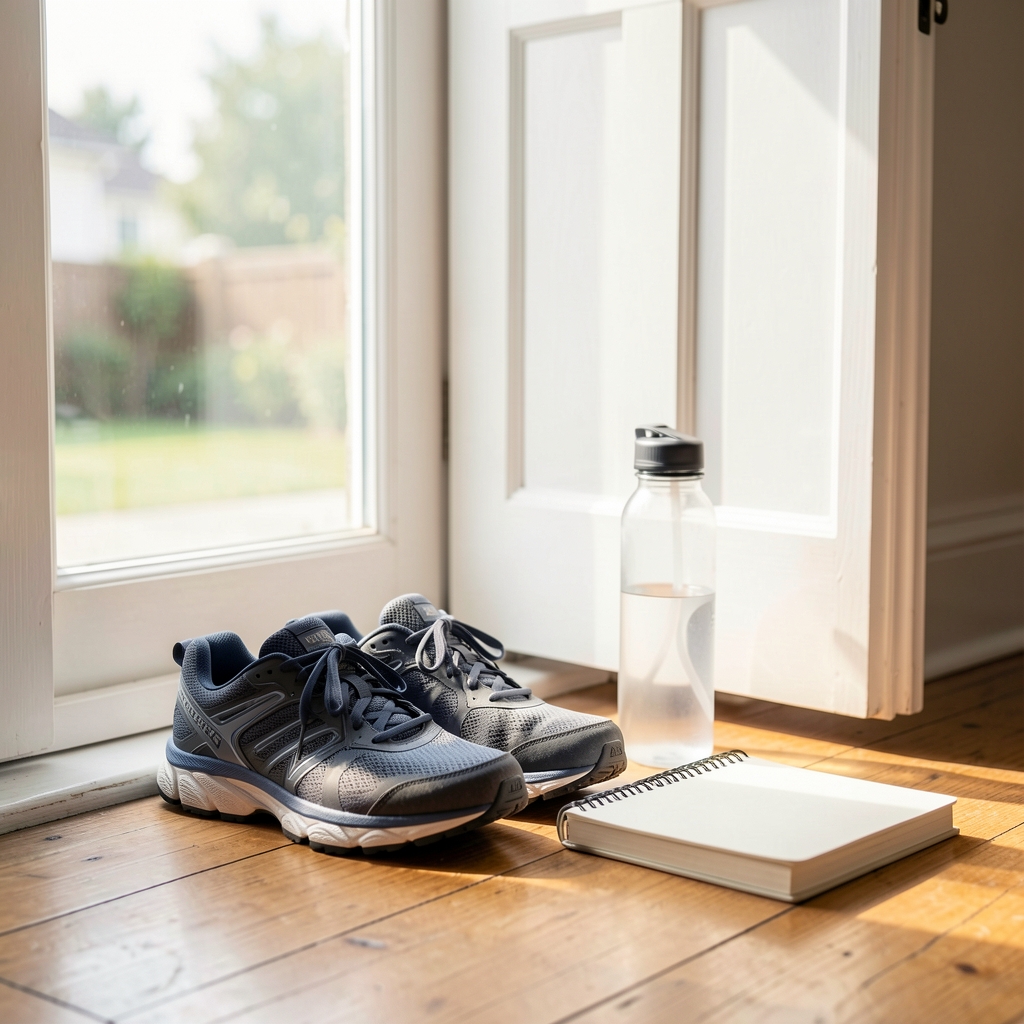
Place walking shoes beside the door, keep a filled bottle on the desk, and prepare tomorrow's breakfast ingredients in advance. Each removed step makes the habit slightly more likely to occur on an ordinary, tiring day.
Published · Last reviewed · Plume editorial desk
Issue No. 2026 / Winter Edition
Habits become easier to repeat when the first physical step is visible and the surrounding friction is understood.
A routine is a kindness you arrange in advance for the version of you who will be tired.
Attach one action to something already stable: a short walk after breakfast, a glass of water after brushing your teeth, or a two-minute note before closing a laptop.
Behavioural researchers often describe this as pairing a new behaviour with an existing cue. The idea is not new, and it is not magic. It simply reduces the number of decisions that have to be made at the moment when energy is lowest. In a Jakarta household, the most reliable cues tend to be the ones that already structure the day: the first prayer or the first coffee of the morning, the commute, the return home, the evening meal, and the hour before bed.
Most routines fail for ordinary reasons: they were designed for an imaginary week with no deadlines, no illness, no family obligations, and no traffic. The three ideas below come up repeatedly in the habit literature and in the questions readers send to the editorial team.
Place walking shoes beside the door, keep a filled bottle on the desk, and prepare tomorrow's breakfast ingredients in advance. Each removed step makes the habit slightly more likely to occur on an ordinary, tiring day.
A ten-minute walk repeated on five days is easier to maintain than a sixty-minute session planned for two. Size can grow later, once the pattern has become part of the week and no longer needs effort to start.
Travel, illness, school holidays, and work peaks will arrive. A routine with a defined “minimum version” for difficult weeks can be resumed without the sense of having failed.
The steps below can be completed over a couple of weeks. They are written as a reading aid, not as a programme, and they can be adapted to any season of life.
For one week, simply note when you wake, eat, move, and go to bed. Do not try to change anything. The aim is to learn what the current pattern actually contains, which is often different from what memory suggests.
Choose a moment that already happens every day, such as finishing lunch or arriving home. Write it down in plain words so that the cue is specific: “after I put my keys down” is clearer than “in the evening”.
Decide what the habit looks like on its easiest day: five minutes of walking, one glass of water, or three lines in a notebook. This minimum version is what protects the routine during difficult weeks.
Place the objects needed for the first step where they can be seen. Remove one obstacle, whether that is a charger in the wrong room or a bag that is packed too late at night.
Look at the notes, not at a score. Ask what made the habit easy, what made it hard, and whether the anchor still fits. Adjust one detail and continue.
The table shows how a small anchor and a minimum version can be written down for several common habits. The examples are illustrative; any real plan should reflect your own work hours, household, and health circumstances.
| Habit area | Possible anchor | Minimum version | Optional extension |
|---|---|---|---|
| Walking | After the midday meal | Five minutes outside or along a corridor | A fifteen-minute loop in a shaded area |
| Hydration | After brushing teeth in the morning | One glass of water | A filled bottle kept on the desk |
| Strength | Before the evening shower | One set of a basic movement such as a squat to a chair | Two or three movements, two days per week |
| Reflection | Before closing the laptop | Two lines in a notebook | A weekly five-minute review |
| Wind-down | When the dishes are finished | Dim the lights and put the phone on the charger | Ten minutes of reading on paper |
| Meal preparation | Sunday afternoon | Wash and chop vegetables for two meals | Cook a pot of legumes or grains for the week |
Run through these questions before adding something new. If several answers are uncertain, the plan may need to be smaller.
“The routines that last tend to look unremarkable from the outside. They are short, specific, and slightly boring, which is exactly why they survive a difficult month. Our interest is less in the ideal morning and more in the one that still happens when the week has gone sideways.”
There is no single figure. Published studies report wide ranges, from a few weeks to several months, depending on the person and the behaviour. For that reason, Plume avoids promising a fixed timeline and suggests reviewing a habit after a real, typical week instead.
Return to the minimum version rather than trying to make up for lost time. A missed week is useful information about the design of the routine: perhaps the anchor moved, or the habit was too large for that season.
Not necessarily. A few lines in a notebook are often enough. Detailed tracking can be helpful for some readers and stressful for others, so it is worth noticing which group you belong to.
This page is written for general education and does not replace advice from a qualified health professional. If you have a medical condition, symptoms that concern you, or take prescribed medication, discuss changes to your daily routine with a clinician first. You may also wish to read how we handle sources on the editorial policy page.
Read the editorial policy Continue to movement