With a partner
Start with shared time rather than individual goals. “I would like us to find thirty minutes a few evenings a week” invites collaboration, while “you never let me rest” tends to invite defence.
Published · Last reviewed · Plume editorial desk
Issue No. 2026 / Winter Edition
Partners, friends, family, colleagues, and community influence the conditions in which a habit can thrive.
A private routine becomes more durable when it does not require everyone around you to pretend it is invisible.
Talk about time, food, rest, money, care, and expectations before they become a source of quiet resentment. A respectful conversation can be more useful than a perfect plan.
Many men in their thirties and forties describe a similar pattern: a household is organised around work and care for others, and personal health slips to the bottom of the list without anyone deciding that it should. Nobody is at fault in this situation. It is usually the accumulation of small assumptions, such as who cooks, who gets up early, whose schedule is flexible, and whose rest is considered optional.
Naming those assumptions out loud does not need to be dramatic. A fifteen-minute conversation at the weekend, with a cup of tea and no screens, can be enough to reveal where a small adjustment would make daily life easier for everyone involved.

“Wellbeing is not a solo project when daily life is shared.”
Ask what support looks like in practical terms, listen for constraints, and leave room for each person’s autonomy.
Support can be easy to misread. For one person it means a partner who joins an evening walk; for another it means a household that protects a quiet hour. A useful question is simply, “What would make this easier for you?” and the answer is often smaller and more practical than expected. It is equally useful to ask the other person what they need, since a change in one routine usually touches several others.
In many Indonesian households, health decisions are made in the context of extended family, shared meals, and strong norms of hospitality. These are real strengths, and they can also make it harder to decline a second helping or to leave an event early. The goal is not to challenge those values but to find respectful ways of working within them.
The cards below describe four common situations and a gentle way into each. The suggested phrases are starting points; adapt them to your own relationships and language.
Start with shared time rather than individual goals. “I would like us to find thirty minutes a few evenings a week” invites collaboration, while “you never let me rest” tends to invite defence.
Explain a change as a preference, not a judgement of anyone’s cooking or customs. Offer a specific alternative, such as adding a vegetable dish to the family meal, instead of declining food altogether.
Protect a lunch break or a short walk by describing it as a work-supporting habit. Colleagues often respond well when a boundary is stated plainly and consistently.
Suggest activities that do not revolve around food or late nights, such as a Saturday morning walk, a badminton game, or a visit to a fresh market.
Bring a short written list and say what worries you most first. Clear information at the start of an appointment helps the conversation stay focused.
Notice the stories you tell about being too busy or too old to change. A neutral observation, such as “I have not had a free evening in three weeks”, can be more useful than self-criticism.
Friction around health habits is usually about logistics, not about values. This table pairs everyday tensions with approaches that keep the relationship at the centre.
| Situation | What may be underneath | A gentle response |
|---|---|---|
| Evening meals at different times | Competing work and care schedules | Agree on two shared meals each week and keep the others flexible |
| One person wants early nights | Different sleep rhythms and screen habits | Create a quiet wind-down corner so one person can retire without disturbing the other |
| Exercise feels selfish | Unspoken expectations about availability | Schedule movement at a predictable time and share the household tasks it displaces |
| Feeling unheard about stress | No regular space for check-ins | Set a weekly ten-minute conversation with a simple format: one thing that was hard, one thing that helped |
| Pressure to eat or attend events | Hospitality norms and a wish to belong | Accept the invitation, choose portions you are comfortable with, and thank the host warmly |
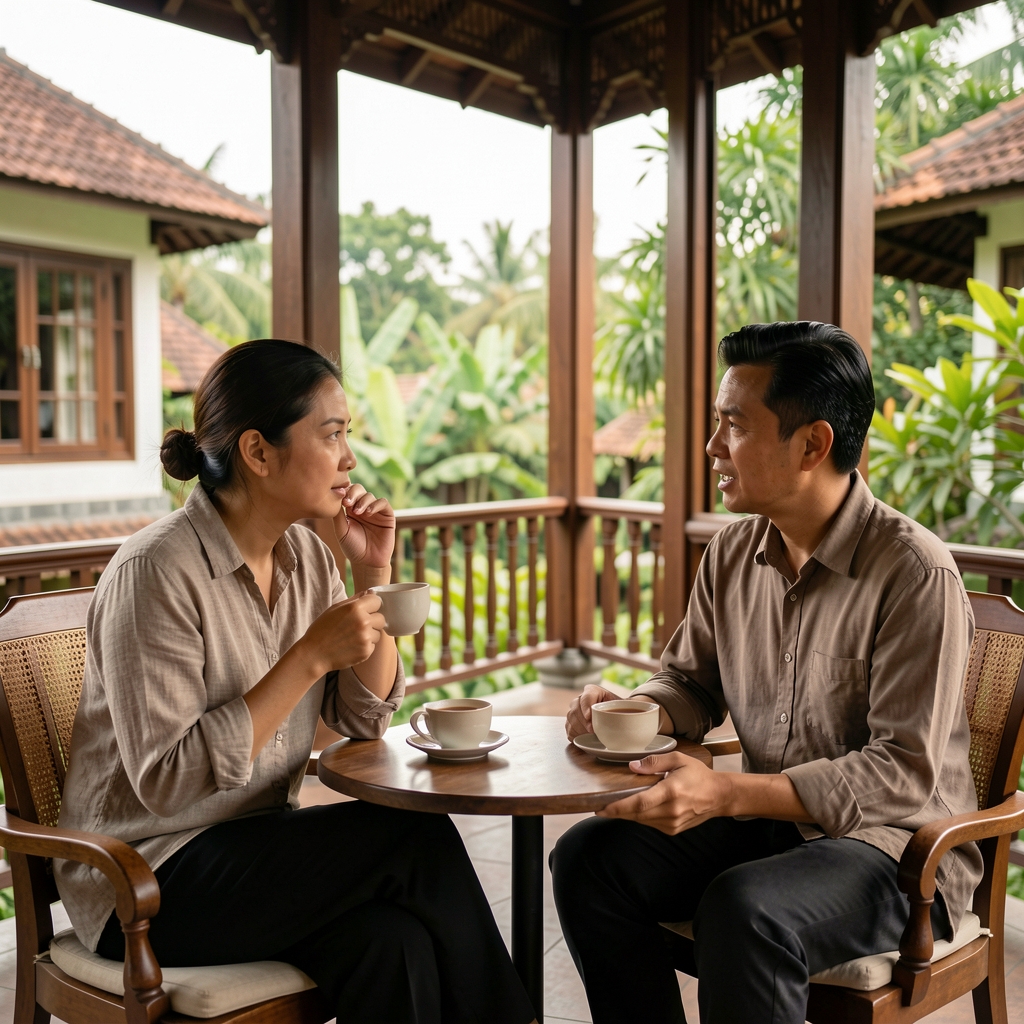
Social connection is widely discussed in public health writing as one of the conditions that shape wellbeing over a lifetime. That does not mean everyone needs a large circle of friends. It means that having at least a few people with whom a real conversation is possible tends to matter.
If a conversation reveals that someone is overwhelmed, hopeless, or unsafe, encourage them to speak with a qualified professional or call a local emergency service. In Indonesia, 112 is the general emergency number and 119 connects to emergency health services.
Change that is imposed rarely lasts. You can still make your own routine visible and explain why it matters to you, without asking anyone to join. Over time, some households find that a calm example is more persuasive than a request.
Choose a private moment, begin with care rather than concern about behaviour, and ask whether they would like to talk. If they decline, leave the door open and respect their answer.
Yes. Many men were taught to manage health privately. Short, factual language and a clear purpose often make the conversation feel more manageable.
Conversations with family and friends can be valuable, but they do not replace professional assessment. If you or someone close to you is experiencing ongoing distress, please contact a qualified mental health professional or a local service. This page is informational and does not provide counselling or medical advice.
Read about stress and focus Prepare for an appointment